
How to Search Criminal Dockets
Begin with MiCOURT Case Search, the statewide portal. Use it when you do not know which Macomb County criminal court holds the case, or when the matter began in a district court. Case number first, always. Note that MiCOURT runs a contains-match on case numbers and a begins-with match on participant names. A broad common-name query can flood you with results. If the first result set does not line up with the notice, city, case type, or hearing information, switch courts and try again.
The county-linked lookup for computerized 16th Judicial Circuit Court and Probate records is CourtView Web Public Access. It does not replace a district-court clerk. For a current setting, a complete file, or an official copy, go to the clerk holding the case. The Circuit Court Section sits at 586-469-5351. The district court serving the complaint location keeps its own criminal record.
- Identify the court from the notice, case number, charge, or issuing location.
- Use MiCOURT for a statewide search and select the correct court before reading a result.
- Use CourtView for a computerized 16th Circuit criminal record, then compare the case history with the case number and parties.
- Check the register for the next setting, charge events, motions, and disposition label.
- Call or visit the holding clerk for a missing entry, a current setting, or an official copy.
Note: Treat a name search as discovery only. The responsible clerk confirms the official criminal file and any current court action.
Macomb County MiCOURT Criminal Searches
MiCOURT can display selected criminal case information. Its public terms describe the display as informational rather than the official record. On the name panel, Last Name or Business is the visible required field. First name, middle name, and birth year are optional. The case-number panel splits year, number, and type into separate boxes. Before calling the clerk, write down the court, case number, party-role label, status, Register of Actions entries, and any hearing setting. That way you can ask about the same matter.
The 39th District Court's criminal information shows the local path clearly. Felony matters start in district court and can leave it after preliminary examination. That court-level distinction is what the official page lays out.
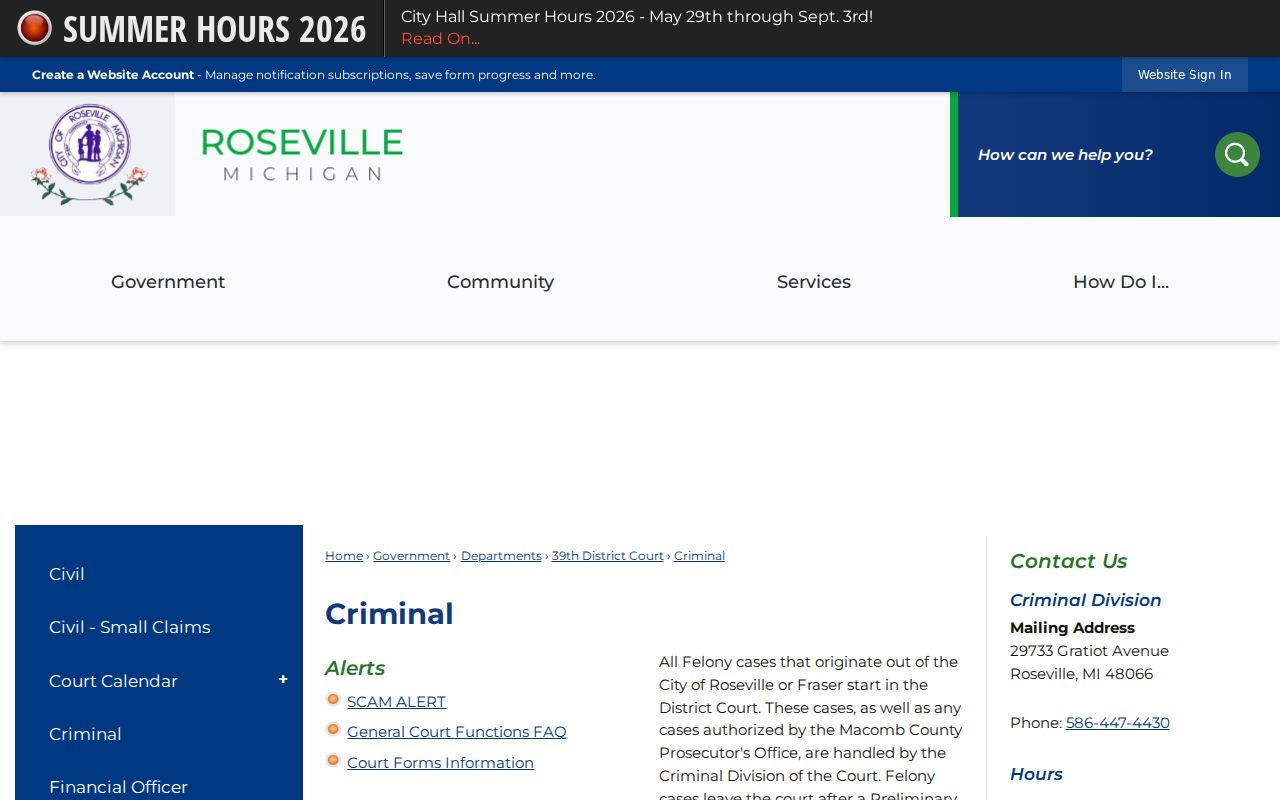
A Macomb County criminal search may therefore need a district result first and a later Circuit result after bindover. One result alone may not show the full procedural path.
What a Criminal Docket Shows
A Macomb County Register of Actions, also called case history, records events. It does not replace every filing. The header usually names the court, division, case number, and filing date. Judge, case type, caption, status, and any available disposition follow. A criminal result may also list the offense, its statutory classification, bond information when public, the hearing setting, and a linked companion or appeal number. Read a line marked filed as an event. The signed order or judgment behind it is the document itself.
| Case number | Use the court's exact identifier; a Circuit form shows the general style 2014-001234-AA. |
|---|---|
| Charge block | May show offense description, statute, degree, and an attempt, conspiracy, or solicitation marker. |
| Case history | Dates and descriptions for charging, arraignment, motion, plea, trial, sentencing, or probation events. |
| Setting | Date, time, room, judge, hearing type, and sometimes remote modality or an adjournment history. |
| Disposition | A portal status such as dismissed, plea, conviction, deferred, or disposed; confirm legal effect from the signed judgment. |
Carry the case number and court with you on every entry. A district record and a later Circuit record can each hold related criminal history.
Macomb County Criminal Court Paths
Criminal dockets in Macomb County begin in the district courts. Those courts handle arraignment and misdemeanor proceedings. They also cover bond and conditions, felony probable-cause work, preliminary examinations, and felony bindover activity. After bindover, the 16th Judicial Circuit Court takes felony cases. It also handles its own arraignments, pleas, sentencing, probation review, and specialty dockets. A city name on a filing points to a location or agency, not a separate city criminal court.
| Case stage | Likely docket holder | Search and confirmation path |
|---|---|---|
| Misdemeanor or preliminary felony stage | District court serving the location | MiCOURT, then the district criminal clerk |
| Felony after bindover | 16th Judicial Circuit Court | CourtView or MiCOURT, then Circuit Court Section |
| Specialty-court assignment | Originating district or Circuit case | Case history plus clerk or Specialty Court Services |
For a felony, pull both the district and Circuit registers. Ask the clerk whether the case history transferred or whether the later court opened a new file number.
Macomb County Criminal Motion Settings
A criminal motion setting can require a source beyond the general case search. Judge-specific pages often separate motions, arraignments, plea settings, sentencings, reviews, and trial dates. Judge Julie Gatti's published calendar, for instance, lists Monday criminal arraignment, on-bond plea, sentencing, and review settings. Criminal and trial settings run Tuesday through Thursday. That is one judge's schedule, not a countywide rule.
Confirm the room, date, and method of appearance on the current judge page. A public case history can identify the next setting. It may omit a current check-in or remote-participation instruction.
Stages on a Criminal Docket
A Macomb County criminal case history may open with a complaint, warrant, or charging document. From there it can list arraignment and bond conditions. A probable-cause conference, preliminary examination, and a bindover or dismissal may follow. Circuit entries that follow often include motion practice, plea, pretrial, and trial. Verdict, sentencing, judgment, and probation review appear there too. Each event answers a narrower question than the overall status field does.
Docket flow: Filing → Arraignment → Pretrial → Plea or Trial → Disposition → Sentencing.
“Scheduled” only means the court event is listed. It does not mean it occurred. “Disposed” signals a recorded closing status without stating the operative legal terms; those live in the signed order or judgment.
Macomb County Criminal Docket Terms
Some entries mark procedural turns that explain why a Macomb County criminal docket changes courts or gains a new date. These are event-history terms. They do not substitute for the text of a court order.
- Bindover
- A district-court felony stage has ended and the matter proceeds to Circuit after the required probable-cause process.
- Arraignment
- The court addresses the charge and related procedure at the opening stage of a criminal case.
- Adjournment or continuance
- A listed hearing was moved; compare the new setting with the case history.
- Restitution or cost assessment
- A recorded financial event, not necessarily a complete public balance statement.
MiCOURT also warns that an attempt under MCL 750.92 can display FELONY even where the underlying offense is a misdemeanor. The court must confirm the statutory classification.
Macomb County Criminal Display Limits
MiCOURT's terms flag a seven-year criminal-sentence display filter at some courts. That note is about the screen, not the case. An older record still exists. The filter simply stacks a time-based display limit on top of the usual court, venue, sealing, and nonpublic-category questions. Those questions shape every docket search.
Missing Macomb County criminal matter you expected? Check the name spelling, the court, the case-number pieces, and the case type first. Then call the holding clerk. Ask what lawful search, inspection, or records-request route is open to you.
Which Court Holds Criminal Dockets
Venue decides where a Macomb County criminal docket lives. The 37th District Court covers Warren and Center Line. The 38th handles Eastpointe. The 39th covers Roseville and Fraser. The 40th serves St. Clair Shores. Sterling Heights, Shelby Township, Clinton Township, Romeo, and New Baltimore sit elsewhere. Those cities fall in other district courts' service areas. Each court keeps its own district court records. So the district clerk is the first call for a district case.
Felony matters move to the 16th Circuit after bindover, the countywide general-jurisdiction court. Its court-records page links CourtView and the clerk channels. MiCOURT works statewide for figuring out which court holds a case. CourtView's reach covers Circuit and Probate computerized records only. MiFILE and TrueFiling handle enabled filings and service, not public docket reading.
Need a local criminal setting? Call the district directly if a case never shows online. The 37th lists 586-574-4900 for Warren and 586-757-8333 for Center Line. The 38th lists 586-445-5020, the 39th lists 586-773-2010, and the 40th lists 586-445-5280. For the others, each district posts its own line. 41A-1 lists 586-446-2500 and 41A-2 lists 586-739-7325. 41B lists 586-469-9300. 42-1 lists 586-752-9679, and 42-2 lists 586-725-9500. Give the clerk the case number, name, charge, and hearing details.
Macomb County Criminal Docket Caseload
Numbers from the state court administrator's 2023 aggregate report help frame the caseload. The 16th Circuit logged 3,452 new felony filings that year. It also logged 308 reopened felony matters. It closed 3,530 and ended 2023 with 1,047 felony matters pending. These are court-wide counts, so they measure neither people nor any single criminal case.
The public 16th Circuit caseload report is aggregate material. It cannot confirm any filing, hearing, or outcome in one case.
Macomb County Criminal File Requests
The Circuit's online order route separates a Register of Actions printout from a criminal sentence, judgment, or other document. A solid request names the court, the case number, the party, an approximate date, the entry or document wanted, and the copy type. Fees on the public form are simple. Regular copies and Register of Actions printouts run $2 per page. A certified copy is listed at $10 plus $2 per page.
Expect processing within 10 business days, per the form. District documents and fees rest with each district clerk. A protected file may call for a different lawful access process. When staff cite a restriction, ask for the governing rule or order.
Public Access and Sealed Criminal Dockets
Michigan court records are public by default. A statute, court rule, or court order can say otherwise. A free result can still be incomplete, delayed, redacted, or unavailable for a given case type. MiCOURT leaves out whole categories. Juvenile and child-protective matters, mental-illness matters, PPO matters, and certain other protected proceedings are excluded. The terms also note a seven-year criminal-sentence display filter at some courts. A blank result is not proof that no case exists.
Macomb access rules.
MCR 8.119 generally permits inspection and copying of public court records, subject to restrictions and reproduction rules.
MCL 712A.28 places juvenile records in a special confidentiality framework rather than ordinary public-docket access.
Macomb's Circuit fee and access page links the local administrative-order trail for inspection, reproduction, and creation of court records.
Macomb County Criminal Docket Limits
CourtView says its information is generated from computerized Circuit and Probate records, is deemed public information, carries no warranty, and should be independently verified. It is useful for locating a case history, not for treating a screen result as the original file. A docket event can note a plea, judgment, or sentence without supplying the full signed document.
Macomb Specialty Court Services manages programs such as Adult Drug Court, DWI/Sobriety Court, Mental Health Court, Veterans' Treatment Court, Swift and Sure Sanctions Probation, and the Specialized Business Court Docket. They are not separate public databases. Search the originating case history and ask the clerk or Specialty Court Services about lawful calendar and records access.
The county's specialty-court page identifies those programs in their public court context.
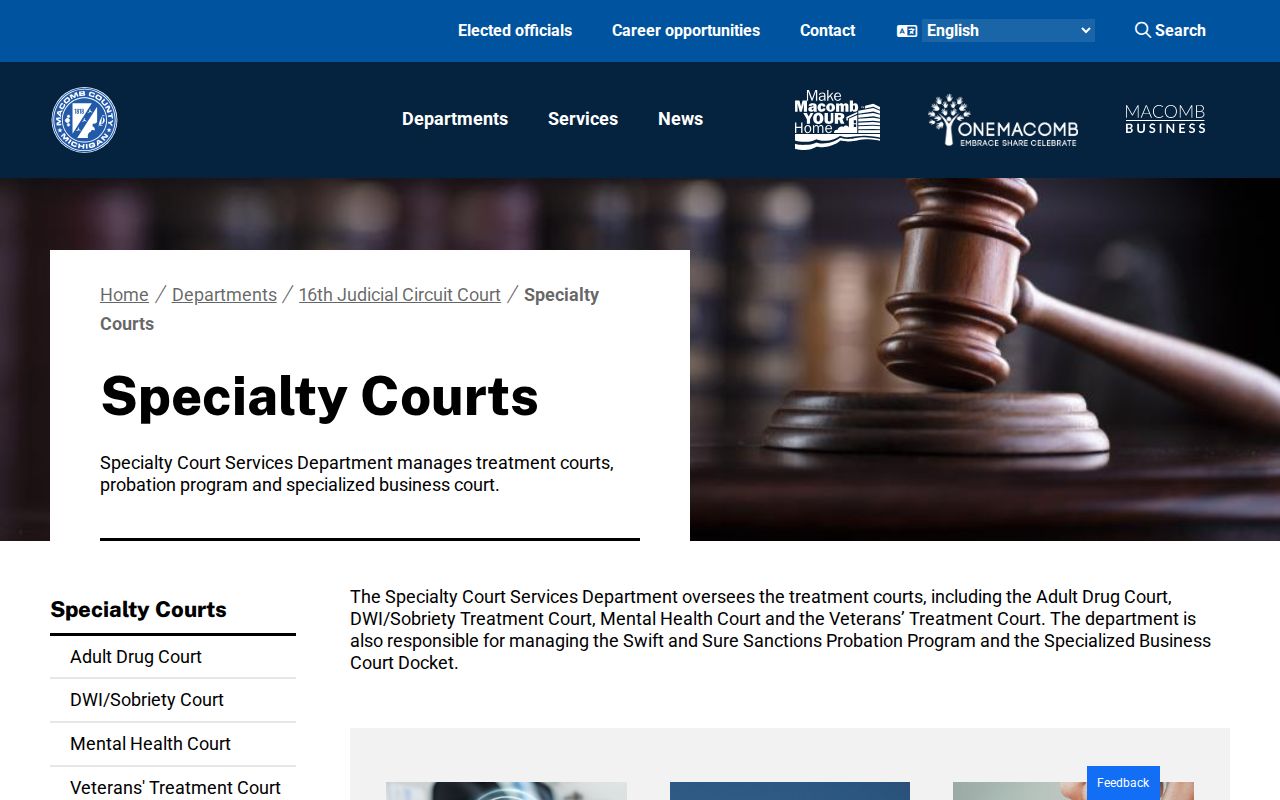
Joining a program can shift judicial assignment and pull in restricted treatment material. So the public criminal docket may hide some program detail. A January 2026 Circuit release announced a civil and criminal docket transition effective February 16, 2026.
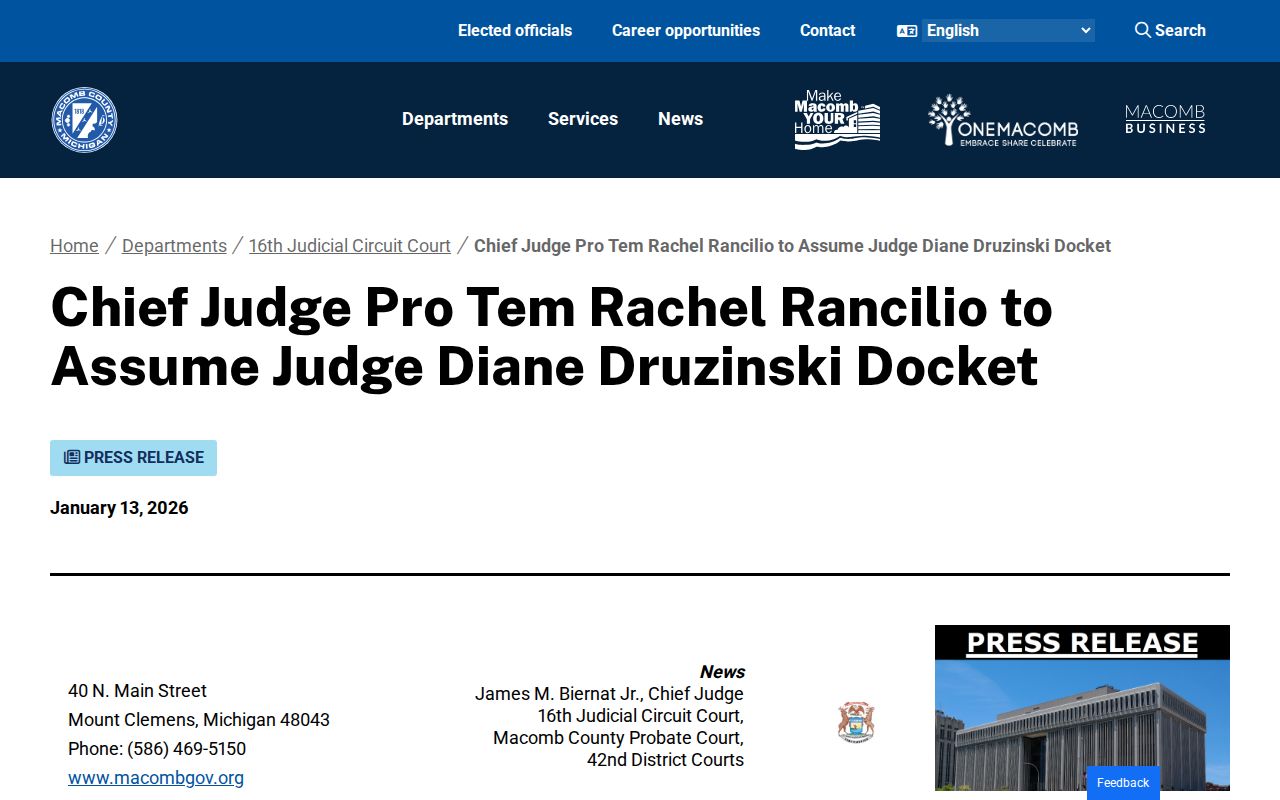
Judges can change on a case. The case number and the underlying court record stay the same. Before relying on an older calendar entry, confirm the current judge and hearing details with the court.